
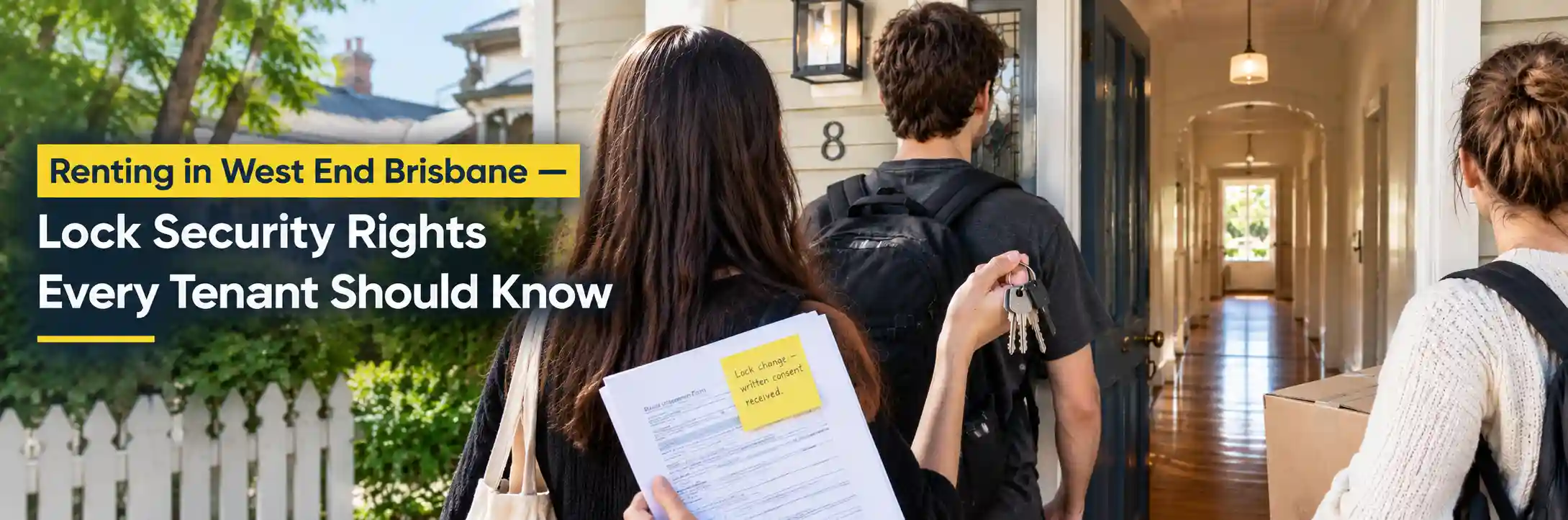
Renting in West End Brisbane means living in one of Queensland’s most distinctive inner-city communities — the Boundary Street café culture, Davies Park on Saturdays, the mix of Queenslander homes and high-rise apartments that gives the suburb its character. It also means renting in a suburb where the vast majority of residents are tenants, not owners.
Renting in West End Brisbane and understanding your lock security rights under Queensland law means starting each tenancy with genuine certainty about who has access to your home.
What QLD law gives you as a West End tenant
The Residential Tenancies and Rooming Accommodation Act 2008 (QLD) is the legislation that governs every residential tenancy in West End Brisbane. Under this Act:
- A landlord must provide residential premises in a good state of repair and fit for habitation — which includes providing locks that are in working order and that reasonably secure the property
- A tenant can request a lock change for security reasons — but in Queensland, unlike some other states, this process requires landlord consent before any work is done, and the specific process depends on the circumstances
- In urgent domestic violence circumstances, a tenant may take immediate action to change locks and must notify the landlord as soon as practicable after doing so
- The Residential Tenancies Authority (RTA) on 1300 366 311 is the Queensland government body that provides free tenancy advice and manages bond lodgement
- QCAT — the Queensland Civil and Administrative Tribunal — handles residential tenancy disputes that cannot be resolved directly between tenant and landlord
Renting in West End Brisbane and exercising your security rights starts with understanding that the QLD framework is different from interstate equivalents. The written request process, the consent requirements, and the dispute pathway all follow Queensland-specific rules.
The lock change request — renting West End Brisbane process
Renting in West End Brisbane and requesting improved lock security follows a specific process under QLD law. The approach that works most consistently:
Before signing the lease, ask the property manager in writing — email is best — whether the property was rekeyed at the end of the previous tenancy and whether you can request a lock change at the start of the new tenancy. Most West End property managers deal with this request as routine and will agree without friction when it is made professionally and in writing before the lease is signed.
If the property manager agrees, get written confirmation before booking any locksmith. In Queensland, a tenant who changes locks without landlord consent may be in breach of the tenancy agreement regardless of the security reason behind the request. Written consent first, then the locksmith.
After the rekeying is done, the landlord is entitled to a copy of the new key — the timing is typically specified in the lease or agreed as part of the lock change consent.
West End’s rental character and the key history problem
Renting in West End Brisbane in a suburb with such a high proportion of renters means that most West End properties have been through multiple tenancy households. The apartment above the Boundary Street strip that has been a rental for fifteen years has had many tenant groups, each distributing keys in the informal ways that tenancy households do — flatmates, partners, regular visitors who were given a copy for convenience.
The key history question is most complex for West End’s older Queenslander-style homes that have been converted to rentals. These properties often have multiple tenancy periods going back decades, with key histories that nobody has formally managed. A rekeying at the start of your tenancy closes all of that history regardless of how complex it has become.
The restricted key blank option — where the cylinder profile is only available through the authorising locksmith, preventing hardware store copies — is worth requesting at any West End rekeying. It means that any key distribution during your tenancy is a documented event, because no copy can be made without going back through the locksmith.
Share houses in West End Brisbane
Renting in West End Brisbane in a share house — a very common arrangement in this community-oriented, arts-and-culture suburb that attracts young professionals, students, and creative community members — has specific key management considerations. A West End share house with three people on the lease and one informal flatmate has key distribution complexity from the move-in date.
The share house key management principle for West End: every person who will regularly access the property has a documented key. When someone moves out — which happens more frequently in West End’s dynamic rental market than in family-oriented suburbs — their key is retrieved before a new flatmate moves in, or the cylinders are rekeyed. The cost of rekeying when a flatmate changes is modest relative to the security benefit of knowing that the departing flatmate’s key no longer works.
For West End share houses with rotating flatmates, specifying restricted blanks at the initial rekeying means that informal copies cannot be made between flatmate changes. Any copy requires the locksmith — which creates the accountability that fast-moving share house arrangements tend not to have otherwise.
Move-in documentation — renting West End Brisbane practical step
Renting in West End Brisbane and protecting yourself starts with the move-in condition report. Under the QLD Residential Tenancies and Rooming Accommodation Act 2008, the condition report is the document that determines what existed at the start of the tenancy and what the tenant is responsible for at the end.
The standard condition report covers walls, floors, and appliances. It is worth adding specific notes about lock mechanisms.
For each external door, note whether the cylinder operates smoothly or requires technique. For each window, note whether the latch engages cleanly. Email the property manager a copy of your annotated condition report with photographs within three days of moving in. This record protects you from being held responsible for pre-existing hardware wear at the end of the tenancy.
In West End’s older Queenslander homes particularly, the condition of window latches and the smoothness of lock cylinders is worth documenting specifically. A wooden window latch on a 1920s Queenslander that has been swelling and contracting through Brisbane summers for a century may be at a point where it does not engage cleanly — and documenting this at move-in rather than discovering it in a dispute at the end is significantly more useful.
Apartment buildings and rooming accommodation in West End
Renting in West End Brisbane in an apartment building or managed rooming house adds layers to the security conversation beyond the individual dwelling. For apartment buildings, the body corporate or owners corporation manages common area security — the building entry, car park, and shared facilities. The individual tenant’s rights apply within the dwelling, but any cylinder change must be compatible with the building’s master key system.
Renting in West End Brisbane in rooming accommodation — a specific category under the Residential Tenancies and Rooming Accommodation Act 2008 QLD — has different provisions from standard residential tenancy. If you are renting a room in a managed rooming house rather than a self-contained dwelling, the Act’s provisions around lock changes and security work differently. The RTA on 1300 366 311 can clarify which provisions apply to your specific arrangement.
The RTA bond lodgement process in Queensland means the bond is held by the RTA, not the landlord, for standard residential tenancies. Any bond dispute at the end of a West End tenancy is resolved through the RTA’s dispute resolution process, and if unresolved, through QCAT. Understanding this process before the tenancy ends — rather than when a dispute arises — means the process is navigable when it matters.
Renting in West End Brisbane and managing the bond correctly at the end of the tenancy includes the lock hardware dimension. Return every key that was issued — apartment, letterbox, gate, any credential provided at the start of the tenancy. Request written confirmation of key return from the property manager.
Any hardware that was already worn at move-in — documented in the condition report and photographs sent at move-in — is not tenant damage. Hardware that deteriorated during the tenancy without the damage being caused by the tenant is a maintenance item, not a bond deduction.
The end of tenancy and bond in West End
A West End student share house that turns over at semester end — when one or more students finish their degree and new students take their place — has a key management event at each transition. The incoming students deserve the same security start as any new tenant: a rekeying, written consent, documented key count.
The practical reality of student share house turnover is that this is often handled informally. The RTA on 1300 366 311 can advise student renters on their rights at each transition.
Renting in West End Brisbane near the University of Queensland Dutton Park campus — within easy walking or cycling distance of the campus — means the suburb’s rental market includes a significant student population. Student renters in West End have the same QLD law rights as any other tenant, but the practical challenges of student share houses are worth noting.
The University of Queensland Dutton Park campus context
Conclusion
Renting in West End Brisbane gives every tenant rights under the Residential Tenancies and Rooming Accommodation Act 2008 QLD. Written request before signing, written consent before the locksmith, documented move-in condition, and managed key count from the rekeying date establish genuine security from the first night. The RTA on 1300 366 311 and QCAT are the resources available when the process does not go as it should.