
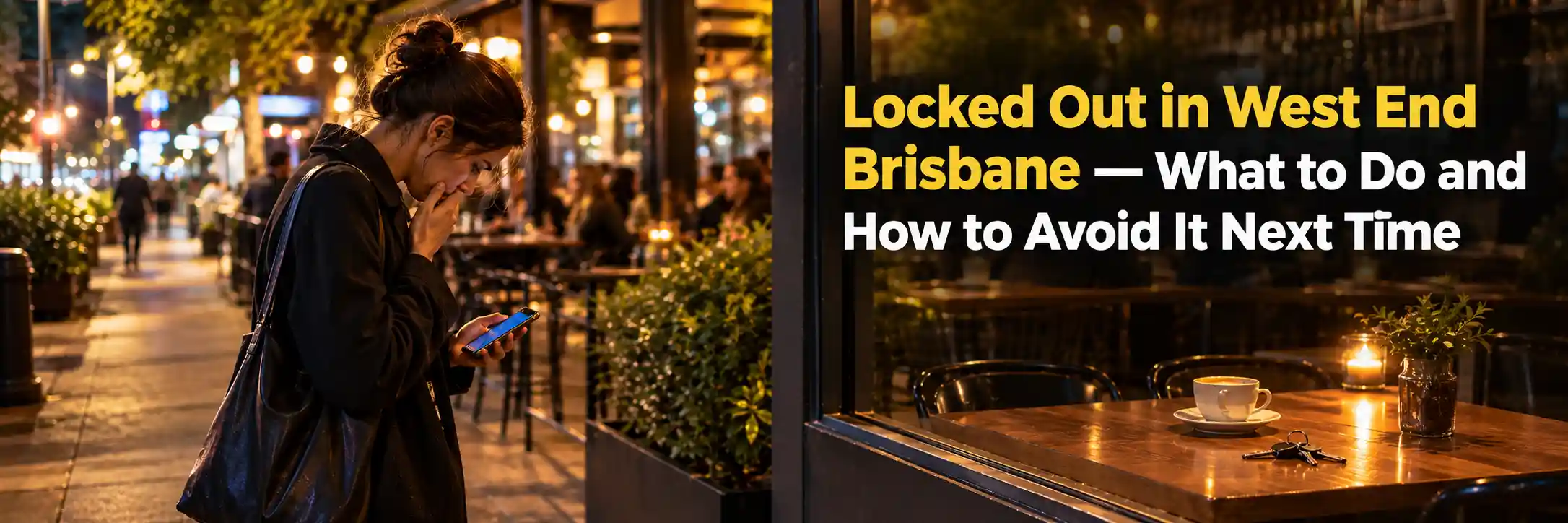
Being locked out in West End Brisbane is an experience that the suburb’s character makes more likely in specific ways than a quiet outer suburban street would. West End is a dense, active, inner-city suburb where people move quickly, share houses change frequently, and the combination of Queenslander homes with their specific entry configurations and high-density apartment buildings creates lockout scenarios that a generic lockout guide never addresses. This is the specific West End lockout guide.
Before you call a locksmith — the West End check
Locked out in West End Brisbane should always start with a systematic check before any locksmith call. West End properties — particularly the older Queenslanders and the subdivided character homes — often have more entry points than residents think about regularly.
Walk the full external perimeter of the property. The laundry entry on the side. The back door that opens onto the rear yard. A louvred window that was left open for ventilation — in a West End Queenslander, this is not hypothetical. Given that louvred windows can have individual blades removed from outside, a window that was left in the open louvre position may provide a point of re-entry that the formal lockout does not.
Also: call any flatmate or housemate who might still have a key. In West End’s share house community, someone else on the lease is often reachable quickly. Call the property manager if renting — the after-hours property manager contact should be in your lease, and a rental property lockout is exactly the situation it exists for.
These checks take five minutes and resolve a significant proportion of locked out in West End Brisbane situations without any locksmith involvement.
The Queenslander-specific lockout
Locked out in West End Brisbane from a Queenslander home has a specific configuration. The elevated home’s primary entry is typically accessed via the external staircase to the verandah — the front door that faces the street from the verandah level. If that door is locked and the key is inside, the locked out position is on the verandah, at the top of the external stair, rather than at street level.
For lower-set West End Queenslanders, the undercroft is worth checking. If there is an unlocked access hatch or maintenance entry in the undercroft that connects to the interior — through a floor access point or a lower-level laundry — this may be accessible. This is also, of course, why those access points should normally be secured.
The louvred window option: in a genuine emergency where a locksmith is unavailable and the situation is urgent, a louvred window on a West End Queenslander may be accessible by carefully removing a louvre blade from outside. This is only appropriate for the resident of the property, is a demonstration of why louvre security matters, and is the kind of entry method that a locksmith call is always better than when time allows.
The share house lockout in West End
Locked out in West End Brisbane from a share house — one of the most common suburban lockout scenarios in this renter-dense inner-city suburb — has a specific dynamic. In a West End share house with three or four people, the statistical likelihood of someone being home when one flatmate is locked out is reasonable. The first step is always to call or message the flatmates before assuming nobody is home.
The less obvious share house lockout in West End is the inter-flatmate key situation. A West End share house where one flatmate made an informal copy of another’s key, or where the key arrangement between flatmates was never formally established, sometimes produces a lockout that is actually a key management failure rather than a simple lockout. The locksmith resolves the immediate entry problem. The key management conversation — who holds which key, documented and formalised — prevents the next one.
The apartment lockout in West End
Locked out in West End Brisbane from an apartment building has two layers. The first is the building entry — the front door, intercom-controlled, that requires either a fob or a resident to buzz you in. If the fob is inside, getting back into the building requires either the building manager, another resident’s goodwill, or a locksmith who can access the building entry.
The second layer is the individual apartment door. These are almost always standard cylinder deadlocks that a locksmith can open quickly. The building manager’s contact should be saved in your phone — they can often arrange access to the building entry faster than a locksmith can arrive and address both layers. Many West End apartment buildings also have a 24-hour concierge or management contact specifically for lockout situations.
If the individual apartment fob was lost rather than left inside — lost at Davies Park, dropped on Boundary Street, left at a café — the situation has the additional dimension of a lost credential that can be used by whoever found it. After the lockout is resolved, the body corporate manager should be notified so the fob can be deactivated. A fob that is lost in a public West End location and not deactivated is an active credential in the hands of an unknown finder.
The Boundary Street scenario — locked out after a night out
Locked out in West End Brisbane after an evening on Boundary Street is a specific and common scenario in this suburb. The combination of West End’s active café and bar culture, the late-night activity, and the share house living arrangements that are common in the suburb means that the late-night lockout — arriving home to find the door locked and the key somewhere inside, or left at the venue — is a regular occurrence.
The preparation for this scenario is simple and worth doing before it happens: save a local West End locksmith number in your phone now. A locksmith who is familiar with West End’s housing stock — Queenslanders, apartment buildings, older subdivided character homes — will arrive with the right approach to each property type. And save your property manager’s after-hours number in the same contact list. The moment of a late-night lockout on Boundary Street is not the time to be searching for either.
After the lockout — what to address
Locked out in West End Brisbane resolves the immediate entry problem. What happens after the lockout matters as much as the lockout itself.
If the lockout was caused by a key left inside: establish a spare key arrangement. A named, trusted neighbour or flatmate who holds a spare key is the prevention for the next lockout. Not a key hidden outside — a specific, contactable person with the key in their possession.
If the lockout was caused by a key lost in public — on Boundary Street, at Davies Park, on a bus — rekey before the property is left unattended. A key lost in a public West End location has been in a dense, active inner-city environment with many people. The rekeying closes the uncertainty. It is not overcaution — it is the correct response to a key lost in public.
If the lockout revealed a hardware problem — a cylinder that stuck, a deadlock that seized, a Queenslander door that swelled in Brisbane’s humidity and jammed — address the hardware while the locksmith is still there, or book a follow-up. A hardware failure that caused one lockout will cause another.
For West End Queenslander residents specifically: identify which windows or entry points in the home might provide re-entry access before a lockout happens, not during one. A calm pre-lockout assessment of the property’s access options is more useful than a stressed mid-lockout exploration of the same options.
Locked out in West End Brisbane is most effectively addressed by the prevention kit that costs nothing and takes ten minutes to set up. A local West End locksmith number saved in the phone — not a national call centre, but a locksmith who knows West End’s housing stock. The property manager’s after-hours number in the same contacts folder. A named, trusted neighbour or flatmate whose number is saved and who holds a spare key, confirmed to be available at the hours when a lockout is most likely.
Prevention — the West End lockout kit
This connectivity is a practical advantage in a lockout situation — but it also means that a West End resident who has left their key at a specific location — at a café on Boundary Street, at a friend’s apartment in nearby South Brisbane, at the Davies Park market — can often retrieve it without needing a locksmith at all. The locked out in West End Brisbane checklist should include: can you reach where the key is? The public transport network makes this more achievable in West End than in outer suburban areas where driving is the only option.
Locked out in West End Brisbane has a public transport dimension that outer suburban lockouts do not. West End is serviced by multiple bus routes, the nearby South Brisbane ferry terminal, and walking distance to South Bank railway station. A West End resident who is locked out has public transport options for reaching a trusted person who holds a spare key, for getting to a locksmith’s premises, or for moving to a safe temporary location while the lockout is resolved.
The public transport lockout in West End
Conclusion
Locked out in West End Brisbane is resolved fastest by working through the property-specific check before calling anyone, having the right numbers already saved, and using the lockout as the prompt to address whatever underlying condition — key management, hardware, or spare key arrangement — will prevent the next one.