
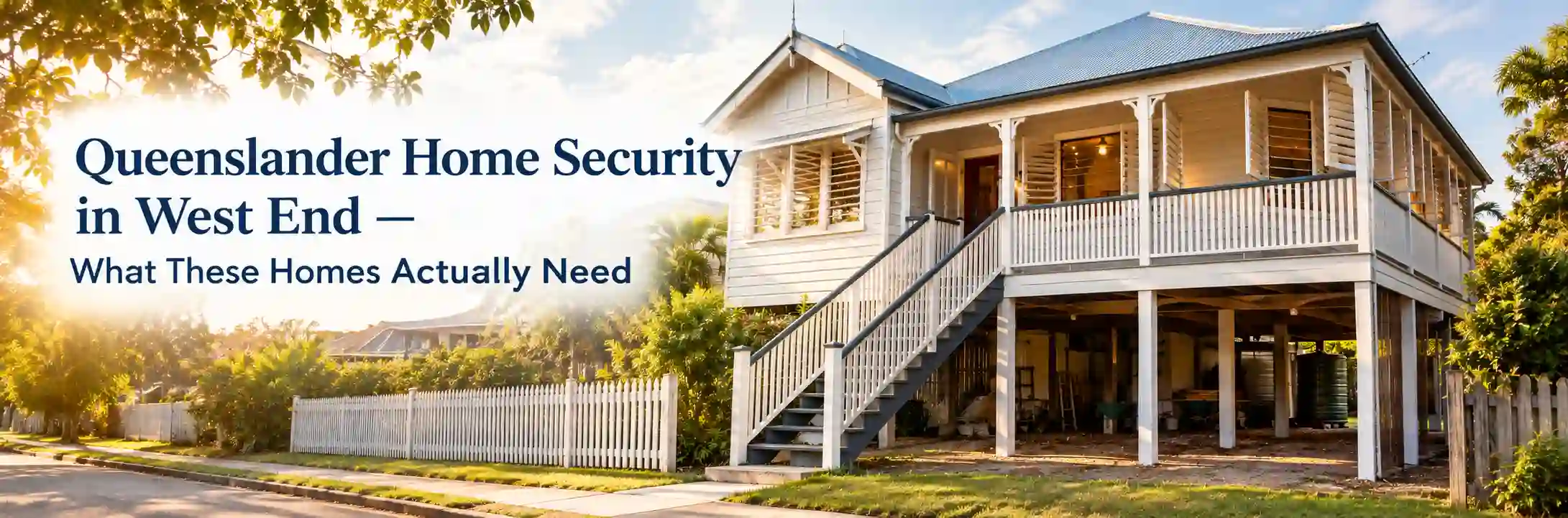
Queenslander home security in West End addresses the security challenges of the suburb’s most iconic housing type. The Queenslander — elevated on timber stumps, wide verandahs, louvred windows, and the cross-ventilation design that makes Brisbane summers liveable — is the architectural soul of West End and the surrounding inner-city suburbs. Queenslander home security in West End recognises that these homes were designed for a different era of Brisbane life, and that their beautiful, climate-adapted design creates specific security gaps that modern security guides, written for brick veneer and concrete construction, have never addressed.
What elevation creates for Queenslander home security West End
Queenslander home security in West End starts with the most fundamental characteristic of the building type: it is elevated. The traditional West End Queenslander sits on timber stumps anywhere from 600mm to two metres or more above ground level, with the space underneath used for storage, parking, or left open. This elevation creates security considerations that ground-level construction never produces.
The undercroft — the space underneath the elevated floor — is the entry point that Queenslander home security in West End most consistently overlooks. An open undercroft is accessible from the street or side passage. Once someone is in the undercroft, they are directly under the living area of the home.
The floor above — tongue-and-groove timber — is the only barrier between the undercroft and the interior of the house. Access hatches in the floor for plumbing and maintenance, if present, are entry points that are rarely secured with any hardware at all.
Queenslander home security in West End for properties with open undercrofts should include: a lattice or solid enclosure of the undercroft perimeter with a keyed gate, an assessment of any floor access hatches for security hardware, and lighting covering the undercroft approach.
Louvred windows — Queenslander home security West End most common gap
Queenslander home security in West End has one finding more consistently than any other: the louvred windows. Adjustable glass louvres — the jalousie windows that provide West End Queenslanders with their characteristic cross-ventilation — are not security windows. Individual louvre blades can be removed from outside by gripping and tilting them while applying slight inward pressure. A louvred window that is “closed” provides almost no resistance to entry.
This is not a new discovery. Louvred windows have been understood as a security vulnerability since their introduction. But in West End’s Queenslander stock — properties that are often rental homes and sometimes heritage-listed — many residents have simply accepted the louvres as a characteristic of the home without considering the security implication.
The solutions for Queenslander home security in West End louvred windows, in order of increasing invasiveness:
- Security film on the louvre blades — adds resistance to blade removal and provides some deterrent value without changing the window’s appearance
- Louvre blade security clips — small clips that secure individual blades in the frame, making removal significantly more difficult
- Security grille on the exterior of the louvre frame — provides genuine resistance but changes the visual character of the window
- Louvre replacement with timber-framed casement or awning windows — the permanent solution that closes the vulnerability entirely at the cost of the louvre character
Which solution is appropriate depends on the property’s heritage status, the tenancy situation, and the homeowner’s priorities. A West End Queenslander with heritage recognition under the Brisbane City Council framework may have constraints on visible external modifications. The Brisbane City Council’s heritage advisory service can advise on what is permissible before any work is planned.
The timber frame and Queenslander home security West End hardware
Queenslander home security in West End for the door hardware involves the specific characteristics of timber-frame construction that differ from brick and concrete. Timber door frames in West End Queenslanders have been through many decades of Brisbane’s humidity cycles — swelling in the wet season, contracting in the dry, and moving with the house as the stumps settle and shift over decades.
The push test is essential for every external door in a West End Queenslander. Engage each deadlock and push firmly at the lock position.
Timber frame movement over decades commonly produces two findings: the strike plate position that was correct when installed is no longer aligned with the bolt, reducing the bolt engagement; and the frame timber at the strike plate position has dried, contracted, or checked in ways that reduce the pull-out strength of the screws anchoring the plate.
Queenslander home security in West End strike plate reinforcement uses longer screws — 75mm or more — into the structural timber behind the jamb. In a Queenslander with a timber stud frame behind the door jamb, this reinforcement is highly effective when the structural stud is sound. A frame condition assessment — pressing the timber at the strike plate position and checking for softness or movement — should precede any reinforcement specification.
The external staircase — Queenslander home security West End access point
Queenslander home security in West End includes the external staircase that provides the primary access to the elevated living area. The external stair of a West End Queenslander is open to the street or front yard, typically with no gate at the base. This means the staircase is an unrestricted approach route to the main entry of the elevated home.
A gate at the base of the external staircase — keyed, with a lock that operates from the garden side — converts the staircase from an unrestricted approach to a controlled one. In West End’s streetscape of continuous Queenslander frontages, a staircase gate is not unusual and is a practical security measure that does not require any modification to the house itself. The gate can be fitted to the stair newel post or to a separate post beside the stair with minimal visual impact.
Verandah security — Queenslander home security West End
The wide covered verandah that defines the West End Queenslander streetscape is one of the home’s most loved features. It is also an access platform that elevates the approach to the home’s main entry. A person on the verandah is sheltered from street observation and is at the same level as the main living area. Queenslander home security in West End for verandah-accessed properties considers:
The verandah door — the sliding or French door that opens from the verandah into the main living area — is typically lightly specified compared to the street-facing entry. For a West End Queenslander where the main access is via the external stair and verandah rather than directly to a front door, the verandah door hardware should receive the same attention as the primary street-facing entry.
Verandah railings and posts provide grip and support that makes the verandah accessible from ground level without the staircase on properties where the elevation is modest. Queenslander home security in West End for lower-set homes where the verandah edge is less than 1.8 metres from ground level should consider whether the verandah perimeter provides sufficient physical deterrence to casual access.
Heritage and rental context
Queenslander home security in West End exists in two specific contexts: heritage-listed or character-significant properties where visible modifications require planning consideration, and rental properties where any modification requires landlord consent.
For heritage-listed West End Queenslanders, the Brisbane City Council’s heritage advisory service provides free pre-application advice. Many security modifications fall within the maintenance category that does not require development approval — but visible external additions, particularly to the primary street facade, may need assessment.
Getting the pre-application advice before purchasing or installing any hardware prevents the situation of installing security measures that then require removal.
For West End Queenslander rentals, the Residential Tenancies and Rooming Accommodation Act 2008 QLD applies to any modification. Written landlord consent before any work. The lock change request that includes the louvre security clips or the staircase gate hardware as part of the scope is a single written request that addresses the Queenslander’s specific security gaps in one conversation.
The annual Queenslander security check in West End should be done during the wet season — February or March — when the humidity effects on timber are at their maximum. Any door that does not close and latch cleanly in wet season humidity needs assessment. The fix is often adjusting the door or strike plate position to accommodate the seasonal timber movement, rather than replacing hardware — but the fix should happen before the wet season produces a door that the household cannot close properly.
Queenslander home security in West End has a specific maintenance dimension that Brisbane’s subtropical climate creates. The extreme humidity swings between Brisbane’s wet season and dry season cause timber to expand and contract — and these movements affect door and window operation in ways that directly impact security. A West End Queenslander’s external door that latches cleanly in the July dry season may swell to the point of not latching at all in February wet season humidity. A cylinder that operates smoothly in dry conditions may swell and stiffen with humidity.
The Queensland humidity and Queenslander lock maintenance
The Brisbane City Council’s heritage advisory service provides free pre-application advice for owners of heritage-listed properties. For West End Queenslanders in character overlay areas, the City Plan’s character residential building code guides what modifications are permissible. Security measures that are not visible from the street — louvre blade clips, undercroft hardware, verandah door deadlock — generally fall within the maintenance and repair category that does not require development approval.
Visible external additions, such as security grilles on street-facing louvre windows, may require assessment.
Queenslander home security in West End for properties with heritage recognition under the Brisbane City Council framework requires specific consideration before any external modification. West End has a significant concentration of pre-war Queenslander homes that are either individually heritage-listed or in a character overlay area under the Brisbane City Plan 2014. The heritage overlay affects what visible external changes are permissible without a development application.
Brisbane City Council heritage framework for West End Queenslanders
Conclusion
Queenslander home security in West End addresses the elevation, louvred windows, timber frame, external staircase, and verandah conditions that make these homes uniquely challenging to secure. The undercroft enclosure, louvre blade clips, staircase gate, and verandah door hardware together address what the Queenslander’s beautiful climate-adapted design creates as security gaps.